Strategic Rate Lock Strategies for Debt-Financed 1031 Exchanges in Orange County
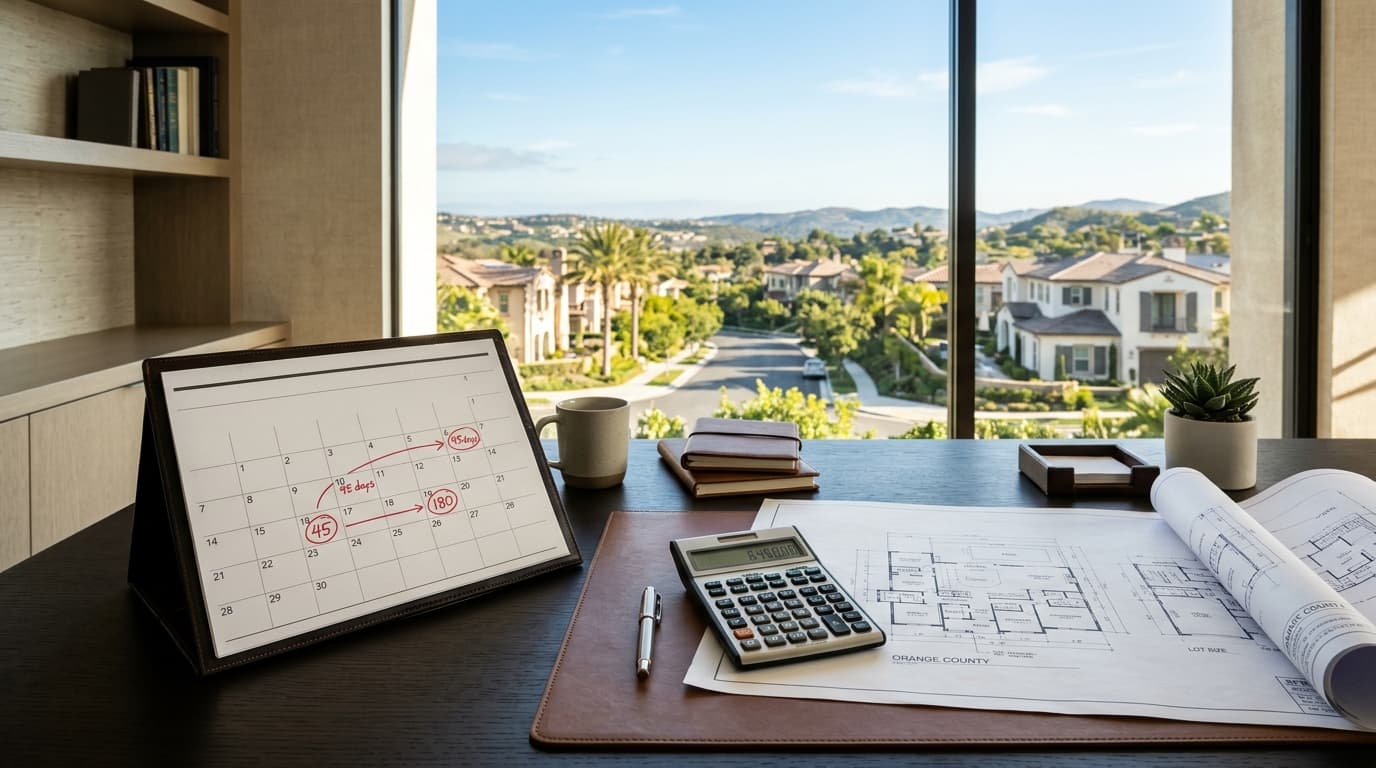
How investors using a 1031 exchange can time financing and rate locks against the 45-day identification and 180-day closing deadlines without risking the exchange.
A 1031 exchange lets an investor defer capital gains tax by exchanging one investment property for another of like kind. It also imposes deadlines that cannot be extended in ordinary circumstances. When the replacement property is financed, the interest rate and loan timeline become part of the exchange strategy. Here is how to think about locking and structuring debt when the clock is running.
The Two Deadlines That Drive Everything
- 45 days to identify: after the sale of your relinquished property closes, you must identify potential replacement properties in writing within 45 calendar days.
- 180 days to close: you must complete the purchase of the replacement property within 180 days of the sale, or by your tax return due date for that year, whichever comes first.
These are strict. A delay in financing is not an excuse the IRS will accept, so loan timing must be built into your plan from the start.
Qualified Intermediary and Debt Replacement
A qualified intermediary holds the sale proceeds so you never take control of them. To fully defer taxes, you generally need to acquire replacement property of equal or greater value and replace the debt you paid off, either with new debt or with additional cash. Discuss the details with your intermediary and tax advisor, because mistakes can create taxable boot.
Why Rate Lock Timing Is Different
In a regular purchase, you lock a rate and close in 30 to 45 days. In an exchange, you may not know your target property until near the end of the identification window, and the closing date is determined by a legal deadline rather than only by convenience. That makes financing sequencing more important.
Practical Strategies
Start financing conversations before you sell. Get pre-qualified for the type of loan you are likely to need, using the profile of the properties you are considering. Knowing your borrowing capacity helps you identify properties with confidence.
Identify with financing in mind. The identification rules allow you to list more than one property, subject to the rules, which can provide backup options. Ensure that each identified property is financeable on terms you understand.
Lock when you have a specific property and a reliable timeline. Once you are under contract on the replacement property, work backward from the closing date. Choose a lock period long enough to cover underwriting, appraisal, and a safety buffer before the 180-day deadline.
Price in the cost of extensions. If the closing date could slip, ask what an extension costs and when it must be requested. A slightly longer initial lock can sometimes be cheaper than an extension later.
Ask about a float-down. If the market improves after locking, a float-down option may allow a lower rate, usually at a price.
Consider structure. Fixed, adjustable, interest-only, and longer fixed-term options each change monthly cash flow. Evaluate them against your hold period and your plan to refinance.
Coordinate Your Team
Successful exchanges depend on cooperation among the qualified intermediary, lender, escrow officer, attorney, CPA, and agent. Give each of them the key dates at the outset. Ask your lender to confirm in writing that they understand the exchange deadline, and ask the lender how quickly they can deliver loan documents.
Watch Out for These Risks
- Late appraisals or underwriting conditions that push beyond the deadline
- Title issues discovered late
- Borrower name mismatches. The entity that sold must generally be the same taxpayer that acquires the replacement property.
- Insurance or inspection delays on older buildings
- Rate swings between identification and closing
Build a Margin of Safety
Aim to close well ahead of day 180. A buffer protects you from surprises. Keep a backup identified property that you would be willing to buy if the first falls through.
Make It a Plan, Not a Scramble
Investors who treat the exchange like a project, with a calendar, roles, and contingencies, tend to have smoother outcomes. If you are considering a 1031 exchange in Orange County, request a 1031 Exchange Target Dossier and we will help you map out target properties and a financing timeline.
This article is general information and not tax, legal, or investment advice. Exchange rules are complex; consult a qualified intermediary, CPA, and attorney.
- #1031 exchange
- #rate lock
- #investment financing
- #Orange County investors
- #45-day rule
- #180-day rule
Planning a sale around this decision?
Request transaction coordination support from Duc Minh Lam. Services requiring real-estate licensure are handled by the applicable licensed professional. See coordination services.
Request 1031 Exchange Target DossierGeneral information only, not legal, tax, or financial advice. Disclosures.